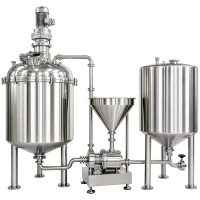

In food processing, the pursuit of superior product quality increasingly demands particle sizes measured in microns - or even sub-microns. Whether producing mayonnaise, dressings, sauces, dairy products, or pharmaceutical emulsions, the ability to achieve consistent particle size reduction and stable emulsions in a single pass distinguishes world-class operations from average ones. The colloid mill has emerged as the technology of choice for these demanding applications, offering capabilities that conventional grinding methods simply cannot match.
The fundamental advantage of the colloid mill lies in its rotor-stator design. Unlike conventional grinders that rely primarily on compressive forces, the colloid mill employs high-intensity mechanical shear generated by the rapid rotation of a rotor within a stationary stator. This high-shear environment creates intense hydraulic and mechanical forces that reduce particles to sub-micron size, producing shelf-stable solutions even with oil and water mixtures that would otherwise separate. With proper adjustment, colloid mills achieve average particle sizes of 0.1 to 25 microns in the processed fluid.
The performance metrics of modern colloid mills are impressive. The Fristam colloid mill, for example, achieves a maximum shear rate of 143,000 per second - approximately four times higher than a conventional shear pump - enabling consistent sub-micron particle size reduction. This level of shear intensity is what allows colloid mills to create stable emulsions with extended shelf life and improved product consistency. The high-shear environment not only reduces particle size but also ensures narrow size distributions, enabling manufacturers to create products with superior performance characteristics compared to conventional processing methods.
The efficiency advantages of colloid milling are equally compelling. Research has demonstrated that specific energy consumption in a colloid mill can be only one-fourth of that required by a mixer grinder, while achieving greater particle size reduction due to the predominant cutting and shearing forces involved. This energy efficiency translates directly to lower operating costs and reduced environmental impact.