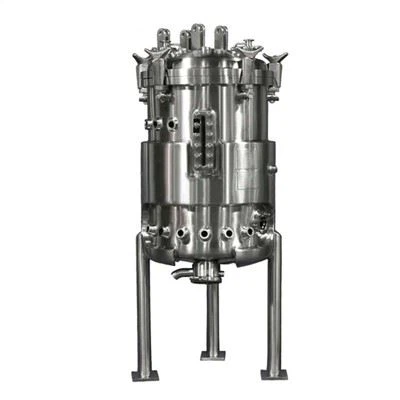


ASME Stainless Steel Pressure Vessel for Food and Beverage Processing 500L to 10000L Sanitary Design
An ASME pressure vessel for food and beverage service must satisfy two sets of rules at the same time. The mechanical code governs wall thickness, nozzle reinforcement, weld quality and relief protection. The hygiene requirement governs surface finish, drainage, cleanability and material traceability. We build this vessel to ASME Section VIII Division 1 design rules in 304 or 316L stainless steel, in volumes from 500L to 10000L. Typical duties include aseptic holding, carbonation, syrup transfer under pressure and preparation of CIP solutions. Every unit ships with a complete documentation package covering material certificates, design calculations and the pressure test report.
Design and Construction
Shell and head thickness are calculated from your design pressure, design temperature, corrosion allowance and joint efficiency rather than taken from a table, so the vessel is neither under built nor needlessly heavy. Heads are dished or conical depending on whether the vessel must be fully drainable. Nozzle reinforcement is calculated for every opening including the manway, sight glass, relief valve and instrument connections. Where the duty calls for temperature control we fit a dimple jacket for heating or cooling, and where the product is sensitive to air we can supply the vessel for vacuum duty with an external or internal dimple jacket.
Sanitary Detail
Food and beverage duty changes the interior specification. Product contact surfaces are polished to Ra 0.8 micrometre as standard and Ra 0.4 micrometre on request, with all interior welds ground flush or orbital welded. The interior is free of crevices and dead legs, connections are sanitary tri-clamp or DIN 11851 rather than threaded, and the vessel drains completely from the lowest point. A CIP spray ball is fitted where clean in place is required. Exterior surfaces are 2B, matte or fully insulated with stainless cladding, which is the usual specification for outdoor installation.
Key Specifications
|
Parameter |
Specification |
|
Volume |
500L to 10000L |
|
Design code |
ASME Section VIII Division 1 design rules, CE PED 2014/68/EU available |
|
Product contact material |
SS304 or SS316L, Ra 0.8 micrometre standard, Ra 0.4 micrometre on request |
|
Design pressure |
Up to 10 bar, higher on request |
|
Design temperature |
Minus 10 to 150 degrees C |
|
Heads |
Dished or conical, fully drainable option |
|
Connections |
Sanitary tri-clamp or DIN 11851 |
|
Jacket |
Dimple jacket for heating or cooling, optional insulation |
|
Cleaning |
CIP spray ball, fully drainable interior |
|
Documentation |
EN 10204 3.1 mill certificates, design calculation, pressure test report |
Typical Applications
Aseptic and sterile holding vessels for dairy and juice
Carbonation vessels for soft drinks and beer
Syrup, concentrate and flavour transfer under pressure
CIP solution preparation and recovery tanks
Buffer and surge vessels in beverage filling lines
Deaeration and vacuum vessels for oxygen sensitive products
Certification and Compliance
We are direct with customers about how the nameplate and paperwork are handled, because a mismatch between the two is the most common finding in a customer or authority audit. Where an order is produced under a certified ASME U stamp by our certified partner factory, the nameplate carries the U symbol and the data report is issued accordingly. Where an order is manufactured to ASME Section VIII Division 1 design rules without a code stamp, the nameplate and all documentation state ASME design only. The choice is agreed in writing before production starts. For European delivery the same vessel is normally built to PED 2014/68/EU with a Declaration of Conformity and, where the category requires it, a notified body certificate.
Ordering Information
Please send us the working volume, the product, the design pressure and design temperature, whether the vessel must be fully drainable, and the required connection standards. If you already have a PED category or an ASME stamp requirement, tell us at enquiry stage, because it changes both the procurement route and the lead time. Standard lead time is 35 to 55 days depending on size and certification route. We supply dimensioned general arrangement drawings for approval before any material is cut.
4. FAQ
Q1. Is the vessel supplied with an ASME U stamp?
A. It depends on the route you choose, and we will confirm it in writing at quotation stage. If your project requires a code stamp, the vessel is produced by our certified partner factory under their U stamp with the corresponding data report. If a stamp is not required, we build to ASME Section VIII Division 1 design rules and the documentation states ASME design only. We never mark or describe a vessel as U stamped unless it genuinely is.
Q2. What is the practical difference between ASME coded and ASME designed?
A. A coded vessel is inspected and stamped by an authorised inspector under a certified quality programme, and the stamp is a legal attestation. A designed vessel follows the same thickness, reinforcement and weld rules but is not stamped or witnessed. Both are safe when built correctly. The coded route costs more and takes longer, and for many food and beverage duties in non regulated markets the designed route is what customers actually order.
Q3. Which surface finish should I specify for food contact?
A. Ra 0.8 micrometre is adequate for most beverage and dairy duties including CIP cleaned vessels. Specify Ra 0.4 micrometre when the product is prone to forming films, when you need faster cleaning validation, or when the vessel handles high fat or high protein products. Going smoother than 0.4 micrometre rarely changes cleaning results but does increase cost.
Q4. Can you supply CE PED certification instead of ASME?
A. Yes, and for European installations that is usually the correct route. We build to PED 2014/68/EU with classification determined by the pressure, volume and fluid group, and we provide the technical file and Declaration of Conformity, with notified body involvement where the category requires it. If you sell into both Europe and North America we can supply a dual documentation package.
Q5. What documentation comes with each vessel?
A. Standard documentation includes EN 10204 3.1 mill certificates for all pressure retaining material, the design calculation, weld procedure and welder qualification records, the hydrostatic test report, dimensional and finish inspection reports, and the operating and maintenance manual. A Declaration of Conformity or ASME data report is added according to the certification route ordered.

Hot Tags: asme stainless steel pressure vessel for food and beverage, manufacturers, sanitary, stainless steel, food grade