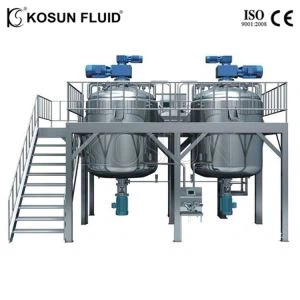


Plant Based Milk Vacuum Emulsifying Tank for Oat Soy and Almond Milk 1000L to 5000L Stainless Steel 316L
Making plant based milk is a powder hydration problem before it is anything else. Oat flour, soy powder, almond paste and rice slurry all clump the moment they meet water at atmospheric pressure, because the outer layer of each particle wets and seals before the inside has a chance to absorb liquid. A plant based milk emulsifying tank solves this by pulling the powder into the liquid under vacuum instead. The tank is evacuated to between minus 0.07 and minus 0.09 MPa, powder is drawn in through a sealed inlet and each particle is wetted under shear before it can form a lump. The same vacuum then strips entrained air from the slurry, which cuts foaming downstream and improves filling accuracy. Volumes run from 1000L to 5000L in SS316L.
How Vacuum Powder Induction Works
The sequence is simple but the timing matters. The vessel is evacuated first, the liquid base is circulated through a bottom mounted rotor and stator running at 2,900 rpm, and the powder is released into the vacuum stream so it enters the liquid as a dispersed cloud rather than a falling heap. Because there is no air in the headspace, there is no surface film to trap the powder on top of the liquid. In practice customers see hydration time fall substantially compared with adding powder to an open tank, and the resulting slurry is uniform enough that downstream filtration and homogenisation loads drop. For soy and oat the process is normally combined with a controlled heat step for enzyme inactivation, typically holding at 80 to 85 degrees C in the jacketed vessel.
Material, Agitation and Cleanability
The inner vessel is SS316L polished to Ra 0.4 micrometre with fully drainable geometry and no threaded product connections, because plant based slurries are excellent at leaving residue in crevices. A slow anchor or turbine agitator at 20 to 60 rpm keeps solids in suspension without whipping air back into the product, while the bottom high shear head handles dispersion. The jacket is a dimple or coil design for steam, hot water or chilled water, so the same vessel can run the heat step and the rapid cool down. CIP spray balls, tri-clamp connections and a full bore outlet are standard.
Key Specifications
|
Parameter |
Specification |
|
Volume |
1000L to 5000L |
|
Product contact material |
SS316L, Ra 0.4 micrometre, fully drainable |
|
Vacuum |
Minus 0.07 to minus 0.09 MPa |
|
High shear |
Bottom mounted rotor and stator, 2,900 rpm, variable frequency drive |
|
Stirring |
Anchor or turbine agitator, 20 to 60 rpm |
|
Heating and cooling |
Dimple or coil jacket for steam, hot water or chilled water |
|
Design standard |
ASME Section VIII Division 1 design rules available, CE PED 2014/68/EU available |
|
Cleaning |
CIP spray ball, sanitary tri-clamp, full bore conical outlet |
|
Control |
PLC with recipe storage, temperature and vacuum logging |
|
Options |
Powder induction funnel, load cells, inline deaeration unit |
Typical Applications
Oat milk and oat base concentrate
Soy milk and soy base for tofu and beverage
Almond, cashew and rice milk
Coconut milk and coconut cream
Plant based creamer and coffee whitener
Non dairy yogurt and dessert base
Pea and other vegetable protein beverages
Certification and Compliance
The vessel is CE marked, with product contact materials conforming to EU Regulation 1935/2004 and EU Regulation 10/2011 and elastomer seals supported by a declaration based on FDA and BfR requirements. Because the vessel operates under vacuum and, in many configurations, under positive pressure for CIP, the design is verified as a pressure vessel rather than a simple atmospheric tank. We can build to ASME Section VIII Division 1 design rules or to PED 2014/68/EU depending on your market, and the route is stated on the quotation so there is no ambiguity at delivery.
Ordering Information
The information we need to specify the vessel correctly is your daily and batch volume, the raw materials and their solids content, the required process temperature profile including any enzyme inactivation hold, the downstream homogenisation pressure, and your CIP chemistry. Standard power supply is 380V 50Hz or 460V 60Hz. A 3000L unit is typically the volume step customers choose when moving from pilot to commercial production. Lead time is 35 to 55 days after drawing approval.
4. FAQ
Q1. Why is a vacuum emulsifying tank better than a simple mixing tank for oat milk?
A. Because the powder never touches air during addition. In an open tank the powder floats, forms a skin and clumps, and you then spend time breaking those lumps down again. Under vacuum the powder is drawn straight into the liquid phase and dispersed by the high shear head. You also remove entrained air, so the product does not foam in the filler and the measured volume per pack becomes more consistent.
Q2. What vacuum level do you operate at?
A. Typically minus 0.07 to minus 0.09 MPa, which is enough to induce powder reliably without boiling a cold product. The exact set point depends on the slurry temperature, because a warm product will flash at a shallower vacuum. We size the pump and control the vacuum against your process temperature, and the set point is logged by the PLC.
Q3. Can the tank handle powder addition continuously rather than in batches?
A. Yes, up to a point. The induction line can be fed continuously from a hopper or a screw feeder while the high shear loop runs, and the PLC holds the vacuum. In practice most customers run powder addition in two or three passes separated by short recirculation periods, because it gives a more uniform hydration and avoids overloading the shear head.
Q4. Is the tank suitable for clean in place?
A. Yes. The interior is Ra 0.4 micrometre with fully drainable geometry, CIP spray balls are fitted, and all product connections are sanitary tri-clamp. A typical cycle is a rinse, an alkaline wash at 70 to 80 degrees C, an acid wash where mineral scale is a risk, and a final rinse. The vacuum line and powder inlet need their own short cleaning step, which we detail in the manual.
Q5. What motor power do I need for a 3000L unit?
A. For a 3000L vessel handling a slurry of around 500 to 2000 cP we normally fit a 22 to 30 kW high shear motor with a 5.5 to 7.5 kW agitator drive, both on variable frequency drives. If your base is thicker or you need a faster batch time, we increase the high shear power rather than the agitator power. Send us your viscosity and target batch time and we will confirm the figures.


Hot Tags: plant based milk vacuum emulsifying tank stainless steel, manufacturers, sanitary, stainless steel, food grade