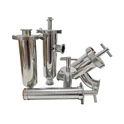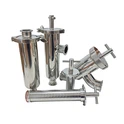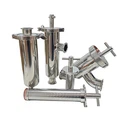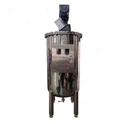

Stainless steel sanitary angle filters are suitable for various industries with strict sanitary standards or requiring efficient filtration. It has the characteristics of corrosion resistance, easy cleaning and compact structure. The specific applications are as follows:
1.Food and beverage industry
Application Scenarios:
Dairy processing: Filter out particles, dust and impurities in milk to ensure the purity of the product. Contaminants in the air, milk jugs and cows, for example, can be intercepted during fresh milk filtration.
Juice and Beverage Production: removal of solid debris, fruit particles and microorganisms from raw materials to improve taste and safety.
Brewing beer: for sterilization filtration of draft beer, in place pasteurization process, while preserving flavor and ensuring asepsis.
Wine and Spirits Filter: Removes the suspension from wine and liquors filter to improve transparency.
Strengths:
The material complies with food-grade standards (such as 304, 316L stainless steel), is nontoxic and heat resistant, and resistant to high temperature sterilization.
The surface is smooth and easy to clean, reduces the risk of bacterial growth and complies with GMP (good pharmaceutical manufacturing practices).
Compact structure, suitable for installation at key points in the production line, such as pipe intersections.
2.Pharmaceuticals
Application scenarios:
Process water treatment: Filter injection water and formulation water to remove particles, suspensions and bacteria to ensure asepsis.
Drug concentration and isolation: In vaccine production, impurities in cell fragments, uninfected cells and viral cultures are filtered.
Terminal filtration: Use of high-precision filters (up to 0.2 microns in filtration accuracy) prior to filling a drug can reliably retain bacteria and ensure drug safety.
Strengths:
corrosion resistance, acid-base chemical environments, prolonging equipment lifespan.
The filtration accuracy is high and meets the strict purity requirements of the pharmaceutical industry.
Support for CIP (on-site cleaning) and SIP (on-site disinfection) in compliance with hygienic design standards.

3. Chemical and Petroleum Industries
Application scenarios:
Oilfield injection water treatment: filtration of suspended oil and solid particles to prevent the formation or corrosion of blockage equipment.
Deep treatment of petrochemical wastewater: removal of organic matter, heavy metals and colloids from wastewater to achieve reuse or compliance.
High temperature and high pressure conditions: In petrochemical production, for example, filters need to withstand high temperature (e.g. 200°C) and high pressure (e.g. 350 bar or even 500 bar) to ensure stable operation.
Strengths:
This kind of material can withstand high temperature, high pressure, strong corrosion resistance, can adapt to harsh environment.
Strong structure reduces maintenance frequency and downtime risk.
Filters can be tailored to different particle size requirements.
4. Electronics and Semiconductor Industry
Application scenario:
Ultra-pure water production: Filters The effluent from systems such as filtration reverse osmosis (RO) and nanofiltration (NF) to remove trace suspensions, colloids and microorganisms, meeting electronic water standards.
IC cleaning: Filter out impurities in the cleaning solution to prevent contamination of the chip surface.
Strengths:
Filtering is highly accurate and can intercept nanoparticles.
The material is non-magnetic, avoiding interference with electronic devices.
The structure has strong sealing properties to prevent external pollution.
5. Water Treatment and Environmental Industry
Application scenario:
Drinking water Purification: Removing suspended solids, rust, sediment and odors from water to improve water quality.
Wastewater treatment reuse: as a pretreatment or security filtration to protect subsequent membrane equipment (e.g., reverse osmosis membranes) from blockage.
Seawater desalination: Filter impurities in seawater, reduce membrane pollution and improve desalination efficiency.
Strengths:
filtration area is large, flow rate is large, processing efficiency is high.
corrosion resistance, suitable for high salinity environment such as seawater.
Easy to maintain, easy to clean and reduce the running cost.
6. Other industries
Mechanical: Filters out metal particles in hydraulic oil and lubricants to protect precision components of equipment.
Textile printing: filter out impurities in dyes, prevent nozzle blockage and improve dyeing uniformity.
Bioengineering: Filter bacteria, proteins, etc. in fermentation liquid to purify product.