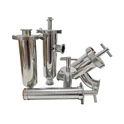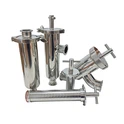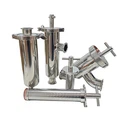

When using stainless steel sanitary angle filter, it is necessary to consider the installation, operation, maintenance, safety, compliance and so on in order to ensure its efficient and stable operation, in accordance with health standards. Here's a rundown of key things to know:
I.Pre-installation Inspection
Material and Process Verification
Confirm that the filter material (e.g. 316L stainless steel) meets the corrosion requirements of the medium and avoid leakage or contamination due to the material's failure to resist corrosion.
Check that the solder is smooth and crack-free and that the surface is polished to hygienic standards (e.g. Ra ≤ 0.8 μm) to prevent bacterial growth.
Sealing test
Before installation, perform a pressure test (usually 1.5 times the working pressure) to check for leaks in soldering points, flange connections or clamp areas.
For sanitary chuck connections, replace the new sealing gasket to avoid the use of aged or damaged gaskets.
Direction and process validation
Install the medium direction arrow as indicated on the filter to ensure the flow of fluid from the inlet to the outlet. Avoid reverse installation, which can reduce filtration efficiency or damage filters.
II. Operating Specifications
Pressure and temperature control
Strict compliance with filter rating maximum working pressure and temperature range. For example, when disinfecting with high temperature steam, it is necessary to verify the temperature resistance of the filter (e.g. 180°C for 30 minutes).
Avoid sudden pressure shock (such as rapid opening/closing of valves) to prevent mesh deformation or seal failure.
Flow matching
Select pump or pipe according to the rated flow rate of the filter. Overrun can lead to faster filter blockage or excessive pressure differential, shortening service life.
Monitor inlet and outlet pressure regularly. When the pressure difference exceeds 50% of the initial value, the filter needs to be cleaned or replaced.
Media Compatibility
Verify media compatibility with filtration materials and seals. For example, for strong acid media, a PTFE sealant should be used to avoid corrosion of the silicone sealant.
Particulate-containing media need to be pre-filtered (such as installing coarse filtration) to prevent large particles from clogging the sieve.

III. Maintenance and regular cleaning
Online cleaning: Applicable for removable filters. Use hot water or a chemical cleanser to recycle to remove residue from the filter surface.
Off-line cleaning: After removing the filter, clean the filter screen with a soft brush or ultrasonic cleaning machine to avoid surface scratches.
Steam sterilization: The pharmaceutical industry needs to use steam sterilization regularly (121°C, 15-30 minutes) to ensure that it is sterile.
Replace filters
Replace the filter screen according to pressure difference or usage period to avoid media contamination caused by the damage of filter screen.
When replacing filters, check that the O-ring or sealing gasket are in good condition. If necessary, replace them together.
Antiseptic measures
When the filter is not in use for a long time, empty the filter of media and store it dry to prevent chloride ions corrosion (as in seawater environment).
Avoid chlorine-containing cleaning agents and opt for neutral or weak base cleansers.
IV. INTRODUCTION Safety and compliance
Blast-proof and static;
In flammable and explosive environment (such as chemical workshop), choose explosion-proof filters and ensure good grounding to prevent electrostatic sparks from causing accidents.
Personnel Protection
Protective gloves and goggles should be worn when cleaning or replacing filters to avoid burns from high-temperature media or chemical cleansers.
When operating at high pressure, keep away from filters to prevent explosion injuries.
Compliance Certification
Verify that filters meet industry certification standards, such as:
Food industry: FDA, 3A hygiene standards;
Pharmaceutical industry: GMP, ASME BPE;
Chemical industry: ATEX explosion-proof certification, PED pressure equipment directive.