


Twin-shaft counter-rotating agitators are widely used in industries such as chemical, food, pharmaceutical, coating, adhesive, new energy, and daily chemicals. Their mixing performance depends not only on the structural design of the equipment itself but also closely on the type of agitator. Different shapes and structures of agitators can generate different fluid motion patterns, such as axial flow, radial flow, shear flow, and circulating flow, thus making them suitable for materials with different viscosities, densities, and process requirements. Appropriate selection of agitator type can not only improve mixing uniformity but also shorten production cycles, reduce energy consumption, and improve product quality. Below are some common agitator types used in twin-shaft counter-rotating agitators and their characteristics.
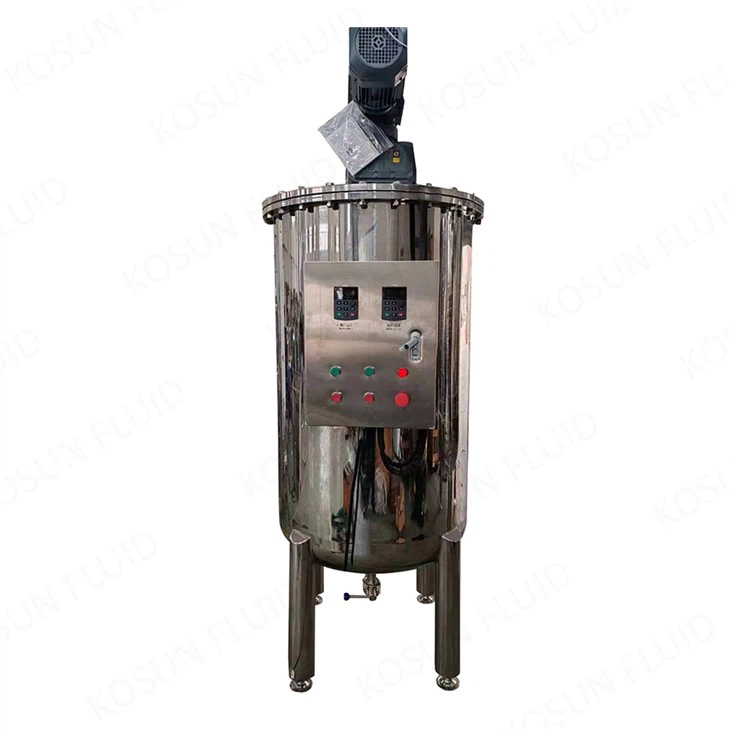
1. Paddle Agitator
Paddle agitators are one of the most common structures in industrial mixing equipment. They typically consist of two or more straight blades, have a simple structure, and low manufacturing cost.
This type of agitator mainly creates axial and radial flow, suitable for mixing, dissolving, and homogenizing low- to medium-viscosity liquids. Due to the relatively fast liquid circulation speed, it is widely used in the production processes of chemical liquids, cleaning agents, liquid fertilizers, and some food ingredients.
2. Anchor-type Agitator
Anchor-type agitators are named for their anchor-like shape. Their blades run close to the tank wall, effectively propelling high-viscosity materials in a circular flow along the tank wall.
This agitation method is particularly suitable for the production of resins, adhesives, latex, syrups, cosmetics, and high-viscosity chemical products. Anchor-type agitators also effectively reduce material adhesion to the tank wall, improving heat transfer efficiency, and are therefore commonly used in agitated tanks with heating or cooling jackets.
3. Frame-type Agitator
Frame-type agitators have a similar structure to anchor-type agitators, but with greater overall rigidity and a larger coverage area, providing more uniform material circulation.
They are suitable for mixing, reacting, and homogenizing medium- to high-viscosity materials, and are particularly suitable for the coatings, inks, sealants, building materials, and fine chemical industries. Because the frame structure can cover a large mixing area, it provides good mixing results for large-capacity agitated tanks.
4. Ribbon-type Agitator
Ribbon-type agitators use an inner and outer double-layer spiral ribbon structure. During rotation, they can propel materials into vertical and radial circulation, achieving three-dimensional mixing. This type of agitator has strong axial conveying capacity, making it ideal for high-viscosity slurries, powder-liquid mixtures, and paste-like products. For example, in the production of lithium battery slurries, putty powders, adhesives, silicone, and some food sauces, ribbon agitators effectively reduce mixing dead zones and improve uniformity.
5. Dispersion Disc Agitator
Dispersion disc agitators typically feature a disc design with serrated edges, generating strong shear force and turbulence at high speeds.
This structure is particularly suitable for materials requiring rapid dispersion, such as pigments, fillers, and powder additives. It effectively breaks up agglomerated particles and improves dispersion efficiency. Dispersion discs are widely used in industries such as coatings, inks, pigments, adhesives, and chemical additives, and are often used in combination with other types of agitators to achieve better mixing results.
6. Combined Agitator
With the continuous upgrading of industrial production processes, more and more twin-shaft counter-rotating mixing tanks are adopting combined agitation systems, where different types of agitators are configured on two agitator shafts.
For example, one shaft uses a ribbon agitator for overall circulation, while the other shaft uses a high-speed dispersion disc for shearing and dispersion; or an anchor-type agitator can be combined with a paddle-type, or a frame-type agitator with a dispersion disc. This design can accommodate multiple functions such as conveying, mixing, shearing, dispersion, and homogenization, better meeting the needs of complex processes and improving product quality and production efficiency.
Summary
Twin-shaft counter-rotating mixing tanks can be equipped with various agitators, including paddle-type, anchor-type, frame-type, ribbon-type, dispersion disc, and combined types, depending on different material characteristics and process requirements. Each type of agitator has its own flow field characteristics and applicable range, and there is no absolute superiority or inferiority. When selecting a model, companies should comprehensively consider the material viscosity, density, particle content, mixing purpose, production capacity, and process requirements to choose the most suitable mixing structure, thereby achieving higher mixing efficiency, more stable product quality, and lower production costs.
FAQ
Q1: Can a twin-shaft counter-rotating mixing tank be equipped with multiple types of agitators?
A: Yes. Many devices adopt a combined design, and different types of agitators can be configured according to process requirements to accommodate multiple functions such as mixing, dispersion, and homogenization.
Q2: Which type of agitator is suitable for high-viscosity materials?
A: Anchor, frame, and ribbon agitators are more suitable for high-viscosity materials, providing strong propulsion and circulation.
Q3: What processes are dispersion disc agitators mainly used in?
A: Mainly used for high-speed dispersion of pigments, fillers, and powders, suitable for industries such as coatings, inks, adhesives, and fine chemicals.
Q4: How to choose the appropriate agitator type?
A: The selection should be based on a comprehensive consideration of the material's viscosity, density, particle size, mixing requirements, production process, and equipment configuration. A combined agitator solution can be used when necessary.
Q5: What are the advantages of combined agitators?
A: Combined agitator systems can simultaneously achieve circulation, shearing, dispersion, and homogenization, improving mixing efficiency, shortening production time, and adapting to more complex production processes.


