
Emulsion Stability Challenges and the Principle of High‑Shear Technology
Mayonnaise and salad dressings are typical oil‑in‑water emulsion systems. Mayonnaise can contain up to 80% oil, making it an oil‑in‑water emulsion where oil is the dispersed phase and water is the continuous phase. In such high‑oil systems, achieving uniform dispersion of the oil phase into the water phase and maintaining long‑term stability is the core challenge in the production process.
Traditional stirring methods often fail to supply sufficient shear force to break oil droplets down to the required fine size. Studies have shown that in mayonnaise production, the raw materials are first premixed in a large‑volume mixing tank at moderate speed; the resulting pre‑emulsion then needs to be processed through a high‑shear device, where the oil droplets are further reduced to their final particle size distribution. This final step is critical for the product's structure, long‑term stability, mouthfeel, and colour.
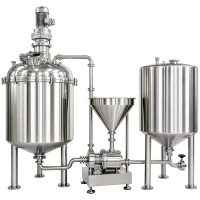
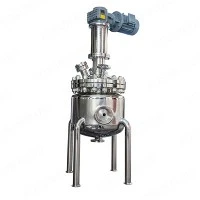
High‑shear stainless steel mixing tanks are designed precisely to address this process pain point. Their working principle is to impart intense mechanical energy to the material through a high‑speed rotating homogeniser head. The material passes through the narrow gap between the stator and rotor, where it undergoes hundreds of thousands of shear actions per minute, while simultaneously being subjected to centrifugal force, compression, impact, and tearing. This high‑intensity shear rapidly and uniformly disperses the oil phase into the continuous phase, forming a stable oil‑in‑water or water‑in‑oil emulsion, ultimately yielding a bubble‑free, fine‑textured, high‑quality product.
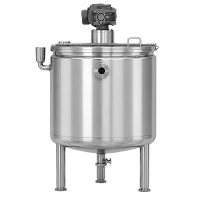
Modern high‑shear mixing tanks are often equipped with vacuum emulsifying systems. The vacuum environment effectively reduces air entrainment during mixing, lowers oxidation risk, and extends product shelf life. Meanwhile, the tank is made of food‑grade stainless steel (304 or 316L), and the internal surface is mirror‑polished to ensure hygienic production conditions.
In terms of equipment configuration, a typical high‑shear mixing system usually incorporates multiple agitators working together. For example, a 500‑litre pressure/vacuum mixing tank may be equipped with an anchor stirrer, a bottom helical impeller, and a multi‑tooth in‑line high‑shear mixer, along with heating/cooling jackets, load cells, and a discharge lobe pump. This multi‑level agitation ensures that the material is thoroughly processed in every area of the tank, eliminating dead zon