
From Tomato Paste to Pasta Sauce – Quality Control Points in the Production Flow
The journey from tomato paste to finished pasta sauce involves a production chain with multiple critical quality‑control points. Tomato paste is a concentrated tomato product, while pasta sauce is a compound seasoning sauce made by blending tomato paste with spices, vegetables, meat, and other ingredients. Although the two products share some equipment, they have distinctly different process control and quality management requirements.
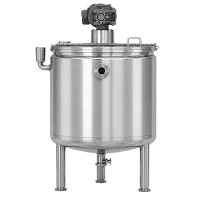
In the tomato paste production stage, the typical steps include washing, crushing, preheating, pulping, concentration, and sterilisation of tomatoes. During this stage, stainless steel mixing tanks are mainly responsible for uniform mixing and heat sterilisation of the tomato puree. Because tomato products are naturally acidic, all internal surfaces in contact with the product must be made of AISI 316 or 316L stainless steel, which has excellent acid resistance and prevents chemical degradation of the product. The tank structure is usually made of SUS304 or SUS316 stainless steel to ensure long‑term durability in acidic environments.
The formulation stage of pasta sauce is the core of quality control. At this point, tomato paste serves as the base and is blended with onion, garlic, herbs, olive oil, meat, and other ingredients through mixing, simmering, and seasoning. This is a typical compounding process that involves uniform dispersion of solid materials (herb pieces, meat particles) in a liquid base, emulsification of fats/oils, and flavour integration.
Throughout the entire production process, the key quality control points include:
Accuracy of ingredient ratios – any deviation in the amount of each raw material affects final flavour consistency.
Mixing uniformity – whether solid particles are evenly distributed in the sauce matrix directly affects the mouthfeel of every finished jar.
Accuracy of the temperature profile – simmering temperature and time determine full flavour release and product safety.
Hygiene and safety – the entire process must comply with food‑grade hygiene standards, eliminating any risk of contamination.
Traditionally, these quality control points relied on operator experience and periodic sampling. However, in large‑scale continuous production, this approach is both inefficient and unable to achieve true full‑batch coverage. This is where video inspection and real‑time monitoring technologies come into play.