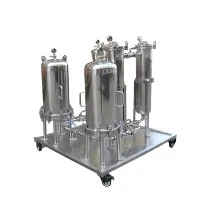

Stainless steel filters are preferred to paper, plastic or cast iron filters for liquid cooling systems. At its core, it adapts to the rigorous operating conditions of 7 × 24 hour continuous liquid cooling in data center liquid, with high precision, low pollution and long service life. It is a necessary configuration to ensure stable heat dissipation, reduce failure and maintenance costs. The specific reasons are as follows:
1.Eliminate secondary contamination and ensure high coolant cleanliness.
Liquid cooling systems rely on the circulation of deionized water and ethylene glycol mixed cooling liquid to heat dissipation. The small aperture of server cooling plate and chip flow channel requires extremely high cleanliness of medium. Paper-plastic filtration materials after long soaking, puffiness, chip shedding, impurity precipitation and so on. Cast iron materials are easy to rust, slag shedding, will constantly contaminate the coolant, block precision heat exchange channels, resulting in equipment high temperature frequency reduction and computing power failure. The 304 and 316L stainless steel materials structure is stable, no fiber shedding, no ion precipitation, can maintain the coolant low conductivity and high cleanliness for a long time, avoid secondary contamination at source.
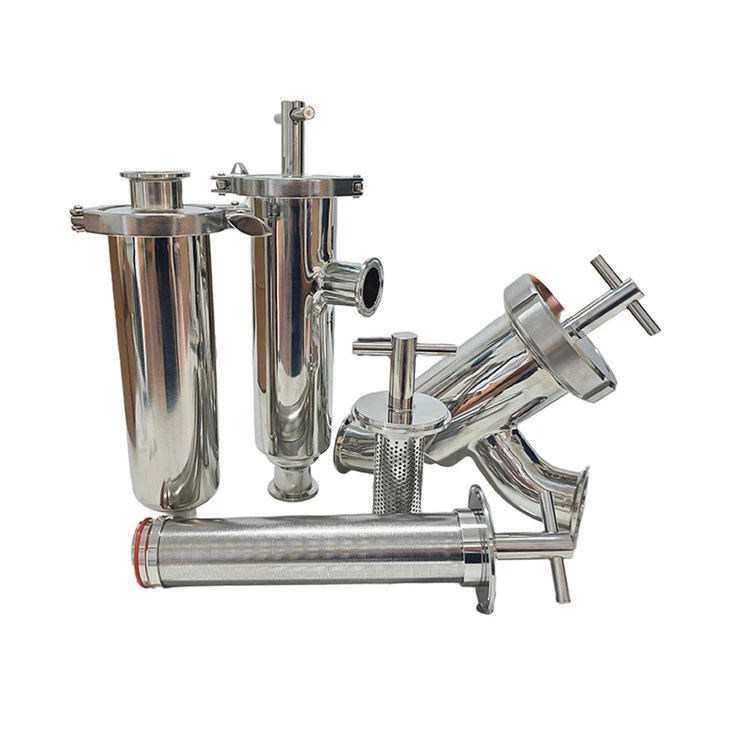
2.Resistant to medium corrosion, suitable for long-term cyclic working conditions
Liquid cooled coolant contains ethylene glycol, corrosion inhibitors and other chemical constituents, has a slightly corrosive, long-term alternation of high and low temperature conditions. The corrosion resistance and temperature resistance of Ordinary filters are weak, and brittleness, cracking and corrosion failure are easy to occur. Stainless steel material has a dense oxidation protective film, acid and alkali, antioxidant, salt spray corrosion resistance. Suitable for all kinds of liquid cooling media, it is suitable for the long-term operation and design life of data centers for 10-20 years, and avoids system failures caused by material corrosion.
3.High structural strength, can withstand high-pressure pipeline impact.
Liquid cooling pipe is affected by pressure fluctuations of circulating pump, water hammer impact, continuous vibration of equipment and so on. Plastic and cotton filters have poor compression resistance and are prone to deformation and leakage under high pressure, creating a risk of fluid leakage in the engine room. The stainless steel filter adopts the welding and forging integration process, has high mechanical strength and can withstand dynamic high pressure and vibration of the pipe. It operates without distortion or leakage, ensuring the safety and stability of the liquid cooling closed circulation system.
4.Stable filtration accuracy and long-term protection of precision hardware
Stainless steel multi-layer sintering machine has uniform and stable pore size, and long-term use will not cause pore expansion or filtration failure. Accurately intercept pipe solder slag, metal metal dust microcolloids small colloids other micron level impurities, and continuously protect core equipment such as CPU, GPU, precision cooling plate and heat heat exchanger, effectively reducing the probability of pipeline sedimentation, hardware wear and heat loss.
5. It is recyclable and greatly reduces operation and maintenance costs.
Ordinary single-use filters require to be frequently closed and replaced, which leads to higher cost of consumables and affects the continuous operation of the computer room. Stainless steel filters are wearable and corrosion resistant. After blockage, it can be regenerated by backwash, water flushing, ultrasonic cleaning, etc., and can be reused without frequent replacement of parts. The downtime and cost of consumables are greatly reduced, which is suitable for the low consumption and efficient transportation of large data centers.
Abstracts
Stainless steel filters have the core advantages of zero secondary pollution, corrosion resistance, high pressure stability, high long-term precision and reusability, which solves the pain points of common filters which are not adaptable, easy to fail and easy to pollute. They are the core guarantee of liquid cooling cooling systems stabilize stable heat dissipation, reduced PUE and prolong the service life of equipment.