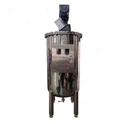

Stainless steel tank-bottom magnetic stirrers, as a kind of high cleanliness and corrosion resistance agitation equipment, requires careful material selection, balancing chemical stability, mechanical strength and hygiene standards. Here is an analysis of the main materials and their application scenarios:
1.304 Stainless Steel (06Cr19Ni10)
Properties: Contains 18% chromium and 8% nickel and is resistant to general corrosive media (e.g. water, organic matter, weak acids and alkalis).
Smooth finish, easy to clean and compliant with Food Grade (FDA) and pharmaceutical industry (GMP) hygiene requirements.
Low cost, good processing performance, suitable for most conventional stirring conditions.
Application Scenarios:
Food industry (beverages, dairy products, condiment stir).
Pharmaceutical industry (pharmaceutical preparations, medium preparation).
Cosmetic production (cleanser, cream homogenization).
2.316L Stainless Steel (022Cr17Ni12Mo2)
Features: 304 stainless steel contains 2% -3% molybdenum and is resistant to chlorine ion corrosion (e.g. salt water, seawater).
Low temperature toughness, suitable for low or high temperature environment (-196°C to 800°C).
Excellent biocompatibility, up to medical grade.
Purpose: Chemical industry (strong acid, strong alkalis, organic solvent stirring).
Marine engineering (seawater desalination, mixing of ship coating).
Biopharmaceuticals (cell culture, vaccine production).
3. Hastelloy C-276
Features: Nickel base alloys containing molybdenum, chromium and tungsten are resistant to spot, crevice corrosion and stress corrosion cracking.
Suitable for highly corrosive media (such as concentrated sulfuric acid, hydrochloric acid, hydrofluoric acid).
High cost, long service life and low maintenance.
Purpose: Hydrometallurgy (acid leaching, extraction).
Chemical production (chlor-alkali industry, organic synthesis).
Environmental protection (waste gas treatment, wastewater treatment).
4. Titanium Alloy (TA1/TA2)
Features: Low density, high strength, corrosion resistance to seawater and chlorine ions.
Good biocompatibility, non-magnetic, suitable for medical devices.
Processing is difficult and costly.
Purpose: Marine engineering (mixing of seawater desalination equipment).
Medical profession (artificial joint, implant production).
Chemical industry (chloride solutions agitation).

5. Polytetrafluoroethylene Coating Material
Features: PTFE is coated in stainless steel substrate that combine metal strength with plastic corrosion resistance.
Resistant to strong acids, strong alkalis and organic solvents. Smooth, nonstick surface.
The coating is easy to wear and requires regular maintenance.
Purpose: Chemical industry (stirring in highly corrosive media).
Pharmaceutical industry (mixing of pharmaceutical liquids to avoid metal ion contamination).
6.Material Selection Criteria
Media Corrosion:
Weakly corrosive media (e.g., water, organic matter) → 304 stainless steel.
Strongly corrosive media (e.g., acids, alkalis, salts) → 316L or Hastelloy.