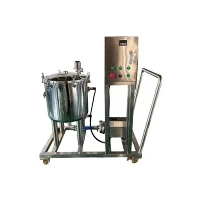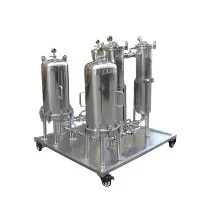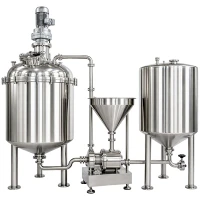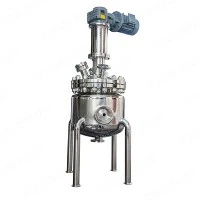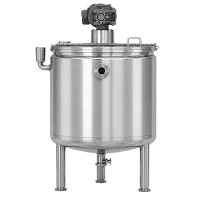

Protein and nutritional drinks are among the least forgiving products to mix. Protein powders hydrate slowly and form lumps on contact with water, the protein foams when it is agitated too hard, vitamins and minerals are sensitive to heat, and anything that does not stay in suspension settles out as sediment in the finished pack. The mixing tank therefore has to dissolve powder quickly, keep the product under control at temperature, and avoid the two failure modes of foam and sediment at the same time.
Dissolving powder without lumps
The reliable way to hydrate protein is to create a vortex at the liquid surface and feed powder into the vortex, where each particle is separated and wetted individually instead of landing in a heap. A dedicated powder and liquid mixer, or a high shear head mounted in the tank bottom, does this more predictably than an open top addition. Very high shear is not always the answer, because over-shearing a protein solution can build foam that is difficult to remove afterwards.
Agitation and temperature control
A variable speed agitator with a marine or pitched blade impeller gives enough motion to keep solids in suspension without entraining air. Where the process needs pasteurisation in the same vessel, a dimple jacket is normally specified and the agitator speed is reduced during heating to limit foam. For high solids formulations a scraper or anchor agitator is used on the wall, and a cone bottom with a flush outlet keeps the solids moving towards the discharge.
Hygiene, allergen control and cleaning
Product contact surfaces are 316L with a controlled finish, and internal geometry is drainable with no dead legs. Where the same line runs a non allergenic product after one containing a declared allergen, cleaning has to be validated for changeover rather than assumed, and the tank design should support that with full drainability, spray ball coverage and no crevices around the agitator shaft seal.
Sizes and ordering information
Units are typically built from 500 litres to 10000 litres, in single wall, insulated or jacketed construction. To quote we need the formulation and its solids content, the target viscosity, the powder addition rate, the process temperature and holding time, the batch size, the agitator type you require, the cleaning regime and the electrical supply. With those inputs the impeller geometry, motor power, jacket area and outlet size can be confirmed.