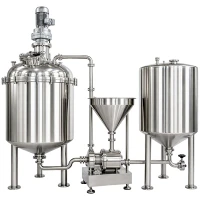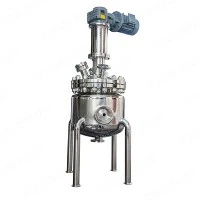

Wet pet food is a meat batter, not a liquid. It is formulated from meat, offal, fat, water and gelling agents, it is cooked in the vessel, and it is then pumped or augered to a filler while it is still hot and thick. That combination of high viscosity, animal protein and a cooking step makes the mixing tank one of the most demanding pieces of equipment in a pet food plant, and it is also the point where hygiene failures are most likely to be introduced.
Cooking and mixing in the same vessel
Most wet pet food lines cook in the mixing tank rather than in a separate cooker, because the batter has to be agitated throughout the heating cycle to avoid scorching on the jacket surface. A jacketed vessel with a scraped or counter rotating agitator keeps the product moving at the wall, which is where heat transfer happens and where a stagnant layer will burn. The jacket handles steam or hot water for the cook, and then cooling water, because the batch has to come down in temperature quickly enough to protect the next process step.
Geometry for a heavy, chunky product
A cone bottom with a large discharge is standard, because a small outlet will bridge on meat pieces and fibres. Where the product contains visible pieces, the agitator has to move them without grinding them to paste, which usually means a low speed anchor or paddle rather than a high shear head. The vessel is fitted with a heavy duty manway for access, and the lid arrangement has to allow ingredient addition without exposing the batch more than necessary.
Hygiene is the design driver
Pet food is a cooked product but it is not sterile, and the pathogens of concern in a wet pet food plant are the same ones that trouble any protein processing line. That means 316L product contact surfaces with a controlled finish, radiused internal corners, no threaded product contact parts, and a vessel that drains completely. Cleaning has to be validated for the actual soil, which is a fat and protein film that water alone will not remove, so the CIP sequence and the spray coverage both matter.
What to specify
Batch size, the recipe and its fat and protein content, the target cook temperature and hold time, the cooling requirement, the maximum particle size, the discharge arrangement, the cleaning regime and the electrical supply. With those figures the jacket area, agitator type, motor power and outlet size can be confirmed rather than estimated.