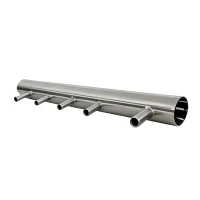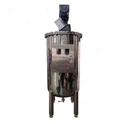

Fixed pressure vessel refers to the pressure vessel installed in a fixed position, which is divided into the following categories:
First, according to the medium hazard classification
1. Media grouping
Pressure vessel media are divided into the following two groups:
(1) The first group of media, the toxic hazard degree is extremely, highly harmful chemical media, explosive media, liquefied gas;
(2) The second group of media, other than the first group of media.
2. Medium hazard refers to the severity of occupational chronic hazards caused by mass contact between medium and human body due to accidents in the production process of pressure vessel, explosion or frequent leakage, expressed by the degree of medium toxicity and explosion risk.
(1) toxic media
The maximum allowable concentration of extremely harmful medium is less than 0.1mg/m³;
The maximum allowable concentration of highly hazardous medium is 0.1mg/m³~1.0mg/m³;
The maximum allowable concentration of medium with moderate hazards is 1.0mg/m³~10.0mg/m³;
The maximum allowable concentration of mildly hazardous medium is ≥10.0mg/m³.
(2) explosive medium
Refers to the explosive mixture of gas or liquid vapor, mist and air to form a lower explosive limit of less than 10%, or the difference between the upper explosive limit and lower explosive limit is greater than or equal to 20% medium.
3. The classification of pressure vessels shall be based on the characteristics of the medium, select the classification diagram according to the following requirements, and then mark the coordinate points according to the design pressure p (unit Mpa) and vessel V (unit m³) to determine the category of pressure vessels:
(1) The first group of media, pressure vessel classification is shown in Figure A-1;

(2) The classification of the second group of media and pressure vessels is shown in Figure A-2.

Two, a specific form of pressure vessel
1. Non-welded bottle container
The pressure vessel is made of high strength seamless steel pipe (nominal diameter greater than 500mm).
2. Gas storage Wells
A tubular well device placed vertically underground for storing compressed air.
3. Simple pressure vessel
A pressure vessel that meets the following conditions is called a simple pressure vessel:
(1) The pressure vessel is composed of a cylinder and a flat cover, a convex head (excluding a spherical head), or a cylinder and two convex heads;
(2) The material of the main compression elements such as the cylinder, head and nozzle is carbon steel, austenitic stainless steel or Q345R;
(3) The design pressure is less than or equal to 1.6MPa;
(4) The volume is less than or equal to 1m³;
(5) The product of working pressure and volume is less than or equal to 1MPa.m³;
(6) The medium is the steam from the evaporation of air, nitrogen, carbon dioxide, inert gas, medical distilled water or the mixture of the above gas (vapor) body; Allow the medium to contain oil and other components that are not enough to change the characteristics of the medium, and do not affect the compatibility of the medium and the material;
(7) The design temperature is greater than or equal to -20℃, and the maximum temperature is less than or equal to 150℃;
(8) Welded pressure vessels that are not directly heated by flame (when the inner diameter is less than or equal to 550mm, the flat cover bolt connection is allowed).
Hazardous chemical packaging, fire extinguishers, quick-opening pressure vessels are not within the scope of simple pressure vessels.
Three, pressure classification
The design pressure (p) of the pressure vessel is divided into four pressure levels: low pressure, medium pressure, high pressure and ultra-high pressure.
1. Low pressure (L) 0.1MPa≤P < 1.6MPa;
2. Medium pressure (M) 1.6MPa ≤P < 10MPa;
3. High pressure (H) 10 MPa≤P < 100 MPa;
4. Ultra-high pressure (U) P≥100 MPa.
Four, use division
According to the principle of function in the production process, pressure vessels are divided into reaction pressure vessels, heat exchange pressure vessels, separated pressure vessels, storage principle vessels. The specific division is as follows:
1. Reaction Pressure Vessel (R)
It is mainly used to complete the physical and chemical reaction of the medium pressure vessel, such as reactor, reaction kettle, decomposition pot, canister, decomposition tower, polymerization tower, autoclave, hyperautoclave, synthesis tower, converter furnace, cooking pot, steam ball, autoclave, gas producer, etc.
2. Heat Exchange pressure Vessel (E)
It is mainly used to complete the heat exchange of the medium pressure vessel, such as shell and tube type waste heat boiler, heat exchanger, cooler, condenser, evaporator electric steam generator, gas producer water jacket, etc.
3. Separate pressure vessel (S)
It is mainly used to complete the fluid pressure balance buffer of the medium and the pressure vessel of gas purification and separation, such as separator, filter, oil collector, buffer, scrubber, absorption tower, copper washing tower, drying tower, stripping tower, cylinder, deaerator, etc.
4. Storage pressure vessel (C, where the spherical tank is B)
It is mainly used for storage, containing gas, liquid, liquefied gas and other media pressure vessels, such as various types of storage tanks.
Safety accessories of pressure vessels include safety valves directly connected to pressure vessels, bursting disc devices, fusible plugs, emergency cutting devices, safety interlocking devices, etc. Details are as follows:
1. Safety valve
Safety valve is mainly composed of sealing structure (seat and valve disc) and loading mechanism (spring or weight, pilot valve), it is a kind of special valve driven by the inlet side of the medium to open the valve disc, pressure relief after automatic closure, belongs to the heavy closed pressure relief device.

2. Bursting disc device
The bursting disc device is mainly composed of the bursting disc (the sensitive element that controls the bursting pressure) and the clamping device (the clamping fixed bursting disc to ensure the sealing and the stability of the bursting pressure). It is a device that drives the bursting disc to break and automatically relieves pressure by the pressure difference between the inlet and outlet medium. It belongs to the non-heavy closed pressure relief device.

3. fusible plug
Fusible plug is the use of low melting point alloy in the device at a higher temperature, open the channel to make the gas from the originally filled fusible alloy hole out of the release pressure, its characteristics are simple structure, easy to replace, the operation pressure determined by the melting temperature is easy to control.

4.emergency cutting device
The emergency cutoff device is generally composed of emergency cutoff valve, remote control system and fusible plug automatic cutoff device. Its function is to close the valve quickly to cut off the air source and prevent the spread and expansion of the accident when the pipeline and its accessories break and misoperation or fire accident occurs near the tank car.
5.quick door type pressure vessel safety interlock device
Quick opening safety interlock alarm device is an effective measure to prevent operation accidents of quick opening pressure vessel. Its functions are:
a. Interlock control function that can boost pressure operation only when the quick door reaches the predetermined closing position;
b. The interlock linkage function of the quick door can only be opened when the internal pressure of the pressure vessel is completely released and the safety interlock device is removed;
c. It has the alarm function synchronized with the above action.