


The debugging techniques of PE diaphragm blower should focus on four core links: temperature control, die head adjustment, cooling system optimization, traction and winding matching. Dynamic adjustment should be made according to the operating parameters of the equipment and the feedback of membrane quality. specific debugging techniques and operational points are as follows:
I.Temperature control: Precise layer-by-layer regulation to prevent degradation of raw materials
Layered heating strategy
Preheat: First, heat the end of the die and screws (such as zones 4, 5 and 6) for 2 hours to 150-180°C to start melting the raw material. Reheat the screw front (sections 1, 2 and 3) to 180-220°C to ensure that the raw material is fully plasticized.
Temperature gradient: Adjusts the temperature according to the melting index (MI) of the raw material. The higher the MI (the more fluid), the lower the processing temperature (e.g., when MI=2g/10min, the temperature can be set at 180-200°C). The lower the MI, the higher the temperature required (for example, when MI=0.5g/10min, the temperature should be set at 200-220°C).
Avoid overheating: Excessively high temperatures (> 230°C) can lead to carbonization of the raw material, resulting in black spots or crystal points. If the temperature is too low (< 160°C), the plasticization effect is poor and the transparency of the film is poor.
Real-time monitoring and adjustment
The temperature of each region is recorded every 30 minutes using infrared thermometers or temperature sensors within the device to ensure a fluctuation range ≤ 5°C.
If abnormal temperature is detected (e.g. sudden drop in mold head temperature), the heating coil or temperature control instrument should be checked immediately to prevent the film bubble from bursting due to temperature instability.
II. Head Adjustment: uniformity of clearance determines consistency of film thickness.
Calibration of die gap
Tool selection: Measure the gap at each point of the die opening using a a professional feeler gauge (accuracy 0.01mm) to ensure gap deviation ≤ 0.05mm.
Adjustment method: Finely adjust clearance through die head adjusting bolt ( (usually M12-M16). Turning clockwise narrows the gap and turning counterclockwise increases the gap.
Validation effect: The uniformity of film thickness was observed after the device was started. If a area is too thick or too thin, focus on adjusting the corresponding die bolts.
2. The die has a clean surface.
After the shutdown, use a copper scraper or compressed air to clean the residual material in the opening of the mold to prevent impurity blockage, causing uneven discharge.
If there is carbide on the inside of the die head, remove the die head, soak it in a solvent (such as white mineral oil) and wipe it clean.
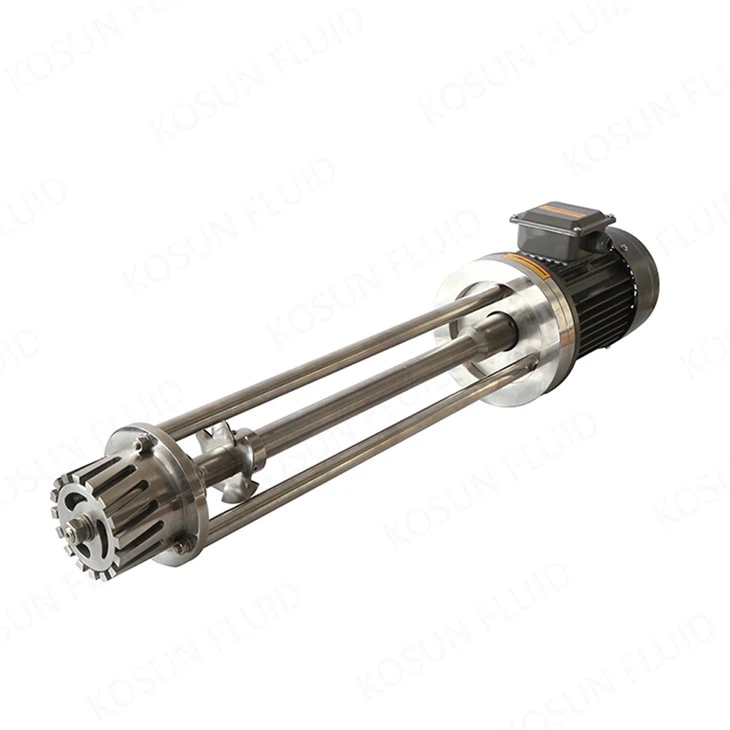
Batch High Shear Mixer
III. Cooling System Optimization: Coordinated Control of Gas Ring and Water Temperature
Wind ring debugging;
2. Wind volume adjustment: Adjust the wind volume of the air ring according to the diameter of the membrane bubble. If there is too much wind (> 5m3/min), the membrane bubbles up. If the air volume is too small (< 2m3/min), the cooling effect will be insufficient and the stiffness of the film will be poor.
Wind direction correction: Wind air velocity around the anemometer is measured to ensure a wind speed deviation ≤ 0.5 m / s at each point to avoid uneven film thickness.
Water temperature control (if using water cooling)
The temperature of the cooling water should be 15-25°C. If the water temperature is too high (> 30°C), the cooling effect will be reduced; if the water temperature too low (< 10°C), the film bubbles may contract too quickly and burst.
Check the cooling pipes regularly for blockages to ensure that water flows smoothly.
Four. Traction and winding match: Tension stability is key
Towing speed adjustment
The traction speed can be determined according to the thickness of the film. In general, the traction speed is 1: 1.2 to the screw speed (for example, when the screw speed is 50rpm, the traction speed is set at 60m/min).
If wrinkles appear on the film, reduce traction speed appropriately. If the film is stretched too thin, increase the traction speed.
Winding tension control
Adjust the winding tension using a tension controller (such as a magnetic powder brake) to ensure that tension is stable at 5-15N (depending on the width and thickness of the film).
V. Comprehensive Commissioning: Trial Production and Parameter Optimization
Test production verification
After the device is started, the stability of the film bubble, the transparency of the membrane and the uniformity of the thickness of the membrane are observed by testing at low speed (e.g., 30 rpm screw speed).
Gradually increase the speed to the target value (e.g., 80-120 RPM) and record each parameter (temperature, screw speed, traction speed, etc.) and film quality data.
Parameter fine-tuning
If there is an "hourglass" phenomenon (periodic change in the bubble width of the film), the screw speed can be increased or the traction speed reduced to prolong film bubble cooling time.
If the film thickness deviation more than 10%, it is important to check whether the die gap, wind volume and traction speed match.
VI. Safety and Maintenance Precautions
Safe operation
Protective gloves and goggles should be worn when debugging to avoid burns or splash damage from high temperature components.
During the operation of the equipment, it is forbidden to touch rotating parts (such as screws, traction rollers, etc.).
Regular maintenance
Check the oil level of the reducer and air compressor oil every 8 hours. If there are deficiencies, they should be replenished in a timely manner (Recommendation 32# Mechanical Oil).
Monthly cleaning of residual material inside the equipment to prevent screw jamming or die head blockage.


