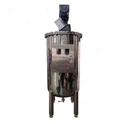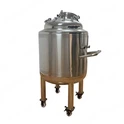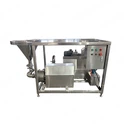

High shear and low shear mixers each have their own unique advantages and disadvantages, which will be explained below:
Advantages and disadvantages of high shear mixers
Advantages:
High efficiency: High shear mixers can quickly disperse, emulsify and mix materials, significantly improving production efficiency. Its high-intensity shear force can make the materials reach a uniformly mixed state in a short time.
High precision: Due to its efficient mixing ability, high shear mixers can ensure the mixing accuracy of materials and are suitable for processes with high requirements for mixing effects.
Wide applicability: High shear mixers have a wide range of applications and can be applied to different materials in different industries, such as food, cosmetics, and pharmaceutical manufacturing.
Environmental protection: High shear mixers usually do not require additional heating or pressurizing equipment during the mixing process, and use the shear force and convection effect generated by mixing to disperse, emulsify and mix materials, reducing pollution to the environment.
Disadvantages:
High energy consumption: Due to its high-speed rotation and strong shear force, high shear mixers usually require higher energy consumption to maintain their normal operation.
There may be some damage to the material: High-intensity shear force may have a certain impact on the structure and properties of some materials, especially materials that are sensitive to shear force.
High equipment cost: Due to the complex design and high technical content of high shear mixers, the equipment cost is relatively high.
Advantages and disadvantages of low shear mixers
Advantages:
Gentle mixing: Low shear mixers avoid excessive shearing to damage the structure and properties of materials through a relatively gentle mixing method, and protect the original characteristics of the materials.
Low energy consumption: Compared with high shear mixers, low shear mixers have lower energy consumption, which helps save energy and reduce production costs.
Suitable for sensitive materials: Low shear mixers are particularly suitable for materials that are sensitive to shear force, such as some fragile, deformable solid particles or powders that are easy to agglomerate.
Simple maintenance: The design of low shear mixers is relatively simple, and maintenance and maintenance are relatively easy.
Disadvantages:
Relatively low mixing efficiency: Due to the low mixing intensity, low shear mixers may take longer to achieve uniform mixing when mixing some materials that are difficult to disperse or emulsify.
Limited scope of application: Compared with high shear mixers, low shear mixers have a relatively narrow scope of application and may not be suitable for all types of materials and processes.
Send feedback
Side panels
History
Saved