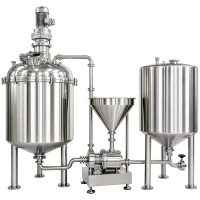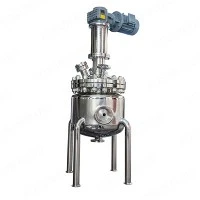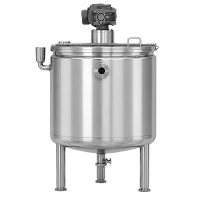

Stainless steel is usually smooth and slightly reflective, but in some cases their surface is grained or brushed in one direction. These different profiles are called surface finishes. An important characteristic of surface finish is surface roughness. This is the deviation of the microscopic crests and troughs from the ideal surface of the metal. The type of surface finish and surface roughness are important specifications for stainless steel mixing tanks because it affects the moisture retention and material adhesion of the mixing tank surface.
Grinding:
This is the basic supply condition of stainless steel plate or steel plate after it is produced from the steel mill. Therefore, mill polish has not been modified by mechanical or chemical means to suit a specific purpose. Manufacturing is usually by hot and cold rolling. Secondary milling operations, such as pickling, are used to enhance the corrosion resistance of stainless steel. A popular finish type for stainless steel tanks is size 2B. 2B is characterized by a smooth surface that is slightly reflective. The average surface roughness Ra is usually in the range of 0.30-0.50 meters. The process used to achieve this smoothness is temper rolling. Other types of mill finishing are No. 1D, No. 2D and BA (Bright Annealed).
Polished, sanded and brushed (mechanical) finishes:
Finishing from a standard mill, an additional process to achieve the desired surface finish. Choose an abrasive polishing grade close to the desired surface properties to reduce polishing effort. Polishing and brushing is accomplished by using abrasive materials bonded to unidirectionally cut belts and discs. The average roughness of this polish varies by application. This is usually done on stainless steel machining tanks, where a specific surface roughness is required on the inner walls to achieve the correct flow of materials when mixing or stirring them.
Electropolishing:
Electropolishing removes or flattens microscopic peaks on metal surfaces. This is achieved by immersing the metal in a heated electrolyte. The metal is then connected to a DC power source and the cathode is also immersed in the electrolyte. When an electric current is passed through the metal, the surface dissolves in the electrolyte solution. Microscopic surface peaks dissolve faster than flat areas. The surface becomes smooth, about less than 0.2 meters. Electropolished stainless steel tanks are used in the food and pharmaceutical industries where product contamination is a problem. The surface of the tank needs to be smooth so that no moisture remains, as moisture can accelerate the growth of microorganisms. Additionally, for agitator tanks with Clean-In-Place (CIP) capability, having a smooth surface prevents product from sticking to the surface, making the rinse phase easy.