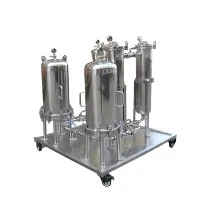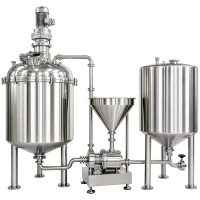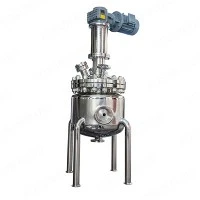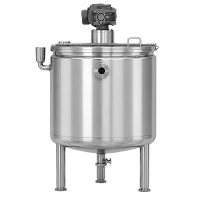

Advantages of Dual-Shaft Counter-Rotation Mixed Tanks versus single-axis mixing tanks:
1.The mixing efficiency is significantly improved
Single-axis mixing has a relatively simple flow mode, the material mainly rotates in one direction, it is easy to form a concave vortices in the center, the edge forms a dead zone. In a biaxial reverserotation, two opposing fluid flows collide and shear each other inside the tank, creating a more complex three-dimensional convection. This means efficient mixing can be achieved at lower speeds, with better mixing uniformity and shorter mixing time.
2.Eliminating "rotation" at all
At high speeds, single-axis rotation can easily create vortices on liquid surfaces, resulting in material splashing, excessive gas entrainment, and significant differences in mixing effect between the center and edge. Two-axis anti-rotation produces anti-torque through both sets of blades, essentially inhibiting vortex formation and maintaining liquid surface stability. This property is particularly important for high-viscosity systems, gas sensing processes and open-loop operating environments.
III. More uniform and controllable shearing force distribution
when stirring on a single axis, shearing force is highly concentrated near the impeller blades and decreases with the increase of blade distance. This can easily lead to "local over-mixing and under-mixing." Biaxial reverserotation causes the material to be repeatedly pressed, stretched and folded between the two sets of blades, making the shear field more evenly distributed. This has significant advantages for emulsion systems (more uniform droplet breakage), dispersion systems (narrower particle size distribution) and high solid suspension system (effective settlement prevention).
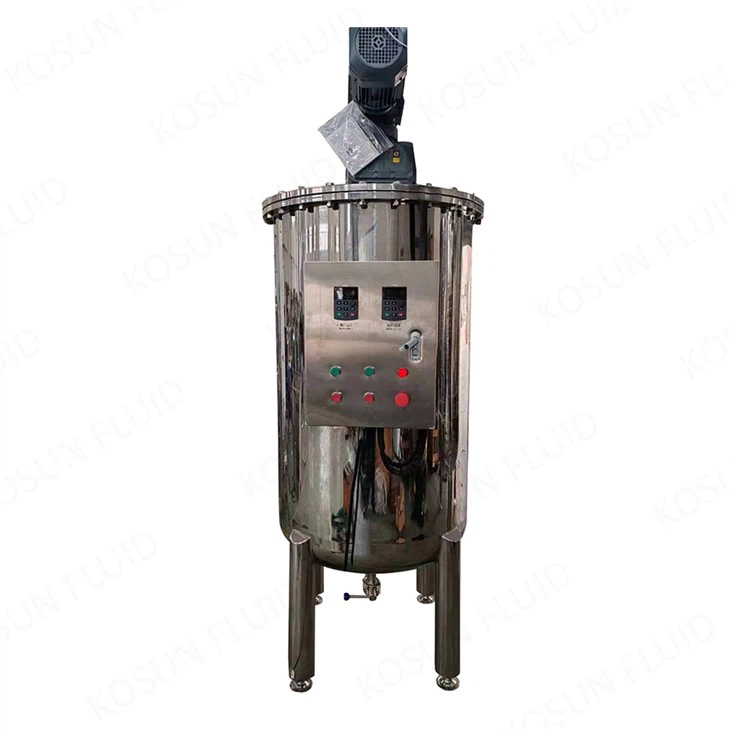
IV. INTRODUCTION Higher energy efficiency
In order to achieve the same degree of mixing, single-axis blending usually requires higher speed and power, while double-axis reverserotation can reduce energy consumption by approximately 30% to 50% (depending on the system). This is because biaxial the counter-current convection reduces inefficient overall rotational energy consumption and converts more energy into efficient turbulence and shearing, ensuring efficient use of each power unit.
Excellent adaptability to High Viscosity and Non-Newtonian Fluids
In highly viscous systems, single-axis systems are prone to "idling" --the blades rotate, but the material is almost immobile, commonly called slippage. The biaxial system, along with its anti-rotating rotor, creates an effective compression push mechanism that can effectively propel the material even at extremely high viscosities, resulting in mass and heat transfer efficiencies that far surpasses that of a single-axis system.
VI. INTRODUCTION More Flexible and Precise Process Control
The biaxial system can control the shear strength, circulation flow rate and residence time distribution by independently adjusting the velocity and direction ratio of the two axes. They can even achieve zoned control functions that a single-axis system cannot: for example, one axis is used for high-speed dispersal and fragmentation, while the other axis is used for low-speed transport and circulation, dealing with both "fragmentation" and "transport" targets.
VII. Reduced Local Overheating and protect heat-sensitive materials
Single-axis systems often require a high speed to achieve mixing effect, resulting in concentrated localized frictional heat, which is very disadvantageous to thermosensitive materials. Two-axis system can achieve the same mixing effect at lower single axis speed, more dispersed and controllable heat generation, more controllable, and safer for thermal sensing system.