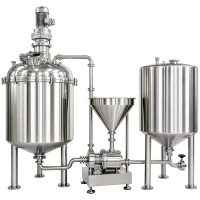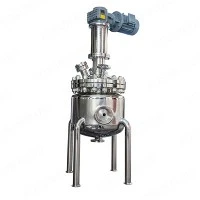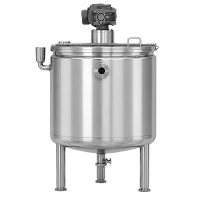


Inline High Shear Mixer
High shear mixers and homogenizers both serve the purpose of material processing, yet they exhibit notable disparities in working principles, structural features, performance capabilities, and application scenarios.
1. Working Principles
High Shear Mixer
A high shear mixer functions by utilizing a high-speed rotating rotor-stator assembly to generate intense shear, impact, and turbulent forces. The rotor, typically operating at speeds ranging from 2,000 to 20,000 revolutions per minute (rpm), closely interacts with the stator. As materials pass through the narrow gap between them, they undergo repeated cutting, tearing, and mixing actions. These actions effectively break down particles, disperse additives, and emulsify substances. While the primary objective is to achieve rapid mixing and a relatively fine particle size reduction, the uniformity of particle size may not be as precise.
Homogenizer
Homogenizers predominantly rely on high-pressure pumping combined with mechanical shearing or impact mechanisms. In a typical high-pressure homogenizer, materials are forced through a small orifice or a set of valves under extremely high pressure, usually ranging from several hundred to several thousand bar. Upon exiting the orifice, the sudden pressure drop triggers intense cavitation and shearing forces. These forces fragment droplets or particles into extremely fine and uniformly sized components. This process excels at creating stable emulsions and suspensions with a narrow particle size distribution.
2. Structural Features
High Shear Mixer
Generally, a high shear mixer comprises a motor, a high-speed rotating shaft, a rotor equipped with multiple teeth or blades, and a stator featuring corresponding slots or holes. Its design can vary significantly; some models incorporate a batch processing tank for mixing operations, whereas others, such as online high shear mixers, are integrated into pipelines for continuous processing. The geometry of the rotor-stator can be customized to meet diverse mixing requirements.
Homogenizer
High-pressure homogenizers are equipped with a high-pressure pump system, which can be a reciprocating piston pump or a diaphragm pump, to generate the necessary pressure. Additionally, they feature a homogenizing valve or a microfluidic device where the actual homogenization occurs. Some advanced homogenizers are further equipped with components like pressure gauges, heat exchangers (to regulate temperature during high-pressure processing), and multi-stage homogenization units to enhance performance.
3. Performance Capabilities
High Shear Mixer
High shear mixers offer relatively high processing speeds and can handle a broad spectrum of material viscosities, ranging from low-viscosity liquids to moderately high-viscosity pastes. However, they often fall short in achieving the extremely fine and consistent particle sizes attainable by homogenizers. Typically, the particle size reduction achieved by high shear mixers is in the range of several to tens of microns.
Homogenizer
Homogenizers specialize in producing very fine particle sizes, often in the sub-micron range (less than 1 micron), and ensuring a high degree of uniformity in particle size distribution. They are capable of creating highly stable emulsions and suspensions that maintain homogeneity over extended periods. Nevertheless, due to the high-pressure requirements of their operation, their processing capacity may be relatively lower than that of high shear mixers, especially when dealing with large volumes.
4. Application Scenarios
High Shear Mixer
High shear mixers are widely utilized across various industries. In the food industry, they are employed for manufacturing sauces, dressings, and dairy products. In the chemical sector, they play a crucial role in dispersing pigments in paints and inks. Within the pharmaceutical industry, they are used for preparing suspensions and ointments. These mixers are well-suited for processes that prioritize fast mixing, dispersion, and basic emulsification, where a high level of particle size uniformity is not the primary concern.
Homogenizer
Homogenizers are commonly employed in applications that demand high-quality, stable emulsions or suspensions. This includes the production of premium dairy products, such as homogenized milk, cosmetics like lotions and creams, pharmaceuticals for manufacturing injectable emulsions and liposomes, and the biotechnology industry for cell disruption and preparation of uniform samples.
In conclusion, although both high shear mixers and homogenizers are integral to material processing, their distinct characteristics make them more suitable for specific tasks, depending on requirements related to particle size, uniformity, and the nature of the final product.