



Jul 03, 2025
Benefits Of Homogenizer Mixing
Improved Product Stability – Prevents sedimentation and phase separation. Enhanced Texture & Consistency – Produces smoother, more uniform products. Increased Bioavailability &ndash...
Read More

Jun 26, 2025
Homogenizer Mixing Principles
Homogenizer mixing is a critical process used across various industries, including pharmaceuticals, food and beverage, cosmetics, and biotechnology, to achieve uniform consistency and particle size...
Read More

Jun 23, 2025
Types Of Storage Tanks
1. Based on Material Steel Tanks: Durable and resistant to high pressure, commonly used for petroleum, chemicals, and water storage. Fiberglass (FRP) Tanks: Lightweight, corrosion-resistant, ideal ...
Read More

Jun 18, 2025
Choosing The Right Mixing Tank
When selecting a stainless steel mixing tank, consider: Material Grade (304 vs. 316 stainless steel). Capacity & Dimensions (based on production volume). Agitator Type & Speed (for optimal ...
Read More

Jun 13, 2025
Applications Of Stainless Steel Mixing Tanks
1. Food & Beverage Industry Mixing ingredients for sauces, dairy products, beverages, and syrups. Fermentation tanks for beer, wine, and yogurt production. 2. Pharmaceutical & Cosmetics Ble...
Read More
Jun 11, 2025
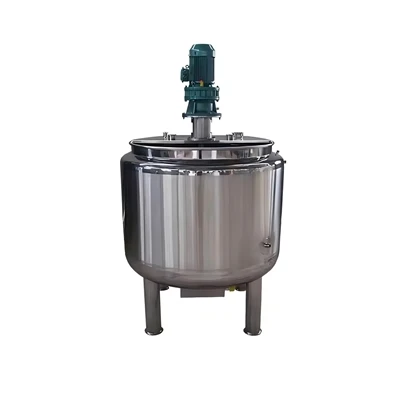
Features Of Stainless Steel Mixing Tanks
industries requiring the blending, storage, and processing of liquids, semi-liquids, and viscous materials. Known for their durability, corrosion resistance, and hygienic properties, these tanks ar...
Read More

Jun 06, 2025
Key Design Considerations For ASME Tanks
ASME tanks must meet rigorous design criteria to ensure structural integrity and operational safety. Key factors include: Material Selection Common materials include carbon steel, stainless steel, ...
Read More

Jun 03, 2025
Choosing The Right Magnetic Mixer
When selecting a magnetic mixer, consider: Capacity – Small benchtop models vs. large industrial mixers. Speed Range – Adjustable RPM for different viscosities. Heating Function –...
Read More